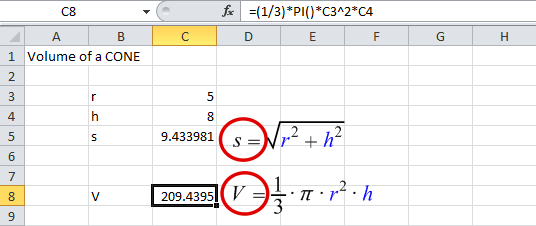
Adds or removes the name of the current cell from the rendered equation. This name is derived from either the 'Name' assigned to the cell being rendered orfrom the text in the cell immediately to the left of it.
Text (but not formulae) in the cell immediately to the left of the selected equation is added to the front of the equation with an operator separating it from the main equation. The default operator placed between the equation is '=', but a variety of alternatives can also be used as they appear at the end of the selected cells label:
| Cell Text | Output |
|---|---|
| a== | $a\equiv b+c$ |
| a<= | $a\leq b+c$ |
| a>= | $a\geq b+c$ |
| a!= | $a\neq b+c$ |
| a=> | $a\rightarrow m-0 p-2 b+c$ |
| a~ | $a\approx b+c$ |
| a~= | $a\simeq b+c$ |
| a~== | $a\cong b+c$ |
| a==> | $a\Rightarrow m-0 p-2 b+c$ |
For existing rendered equations the Display Assignment button will turn on/off this feature for all selected equations.
Display Assignment can be used on its own to render text (usually in LaTeX format) within a cell. To avoid confusion, the original text is hidden by changing its colour to match the background. The rendered text will aligned to the right of the selected cell.Important: The easiest way to restore the original text colour is to select the rendered equation and click the Erase button ().
For example:
| Cell LaTeX | Output |
|---|---|
| \alpha+\beta | $\alpha+\beta$ |
| \int_{0}^{x}13x\cdot dx | $\int_{0}^{x}13x\cdot dx$ |
| f(x)=\int_{a}^{b}K(x,t)\phi(t)dt | $f(x)=\int_{a}^{b}K(x,t)\phi(t)dt$ |
| f\xi =\int_{-\infty}^{x}f(x)e ^{-2\pi ix\xi }dx | $f\xi =\int_{-\infty}^{x}f(x)e ^{-2\pi ix\xi }dx$ |
For help writing LaTeX, use the CodeCogs Equation Editor — Export opens it with the equation already in it — and copy the LaTeX back into the cell in Excel.
Locking it on: hold ⌘ on a Mac, or Alt on Windows, while clicking Display Assignment to set its default without rendering anything — or click it with an empty cell selected. The button then appears permanently selected or deselected, and every equation rendered afterwards adopts that setting. ctrl works too; the button's own tooltip names the key for the machine you are on.
Download the example provided and follow the steps below: